
WETREST is involved in innovative multidisciplinary and transdisciplinary research to enhance our understanding of wetland ecosystems, their functioning, and the threats they face. We strive to generate knowledge that can inform effective conservation and management strategies.
Our strength is working in collaborations and with partners to provide baseline, as well as innovative, new knowledge regarding wetland science. Specifically, we prefer to work alongside communities and interested and affected parties and with partners, to capitalize on the various knowledge types and backgrounds of people to enhance the outcome of our work.
The Freshwater Research Centre (FRC), the Centre for Wetland Research and Training (WetRest), and the University of the Free State (UFS) have jointly commenced a Water Research Commission (WRC) project aiming to update and rewrite the wetland delineation guideline for South Africa. The wetland delineation guidelines of 2005 (“A practical field procedure for identification and delineation of wetlands and riparian areas” (DWAF, 2005)) consolidated existing local and global wetland theory and the current experiential knowledge of wetlands of South Africa, into an easy-to-understand and relevant guideline. This guideline is still today regarded as the baseline for wetland delineation and assessments in South Africa, and, along with an updated draft completed in 2008, is still widely used by practitioners to delineate and assess wetlands, and by governmental officials to evaluate wetland reports. There is a critical and urgent need to update and probably rewrite the guideline, based on the past two decades of wetland research and practice.
WETREST is a key partner in the GEF-8-funded project titled “A Transdisciplinary Approach Towards Restoring Selected South African Peatland Ecosystems and Their Catchments”. This five-year initiative aims to restore the ecological integrity and ecosystem services of three severely degraded South African peatland systems — the Goukou, Molopo, and selected Maputaland peatlands — while enhancing community livelihoods and contributing to global biodiversity and climate goals. Peatlands, vital for carbon storage, water regulation, and biodiversity, are critically threatened in South Africa due to unsustainable land use, water abstraction, and poor governance. This project addresses those challenges through integrated, science-based and community-led interventions, including futures visioning, hydrological modelling, inclusive restoration, and innovative financing mechanisms like carbon and water credits. Partners include the Department of Forestry, Fisheries and the Environment (DFFE), the Agricultural Research Council (ARC), UNEP, and WETREST, with strong collaboration from local communities, academic institutions, and civil society. Together, the project seeks to transform restoration practice, strengthen policy, and secure sustainable, climate-resilient futures for people and nature."
For more info, visit: www.unep.org

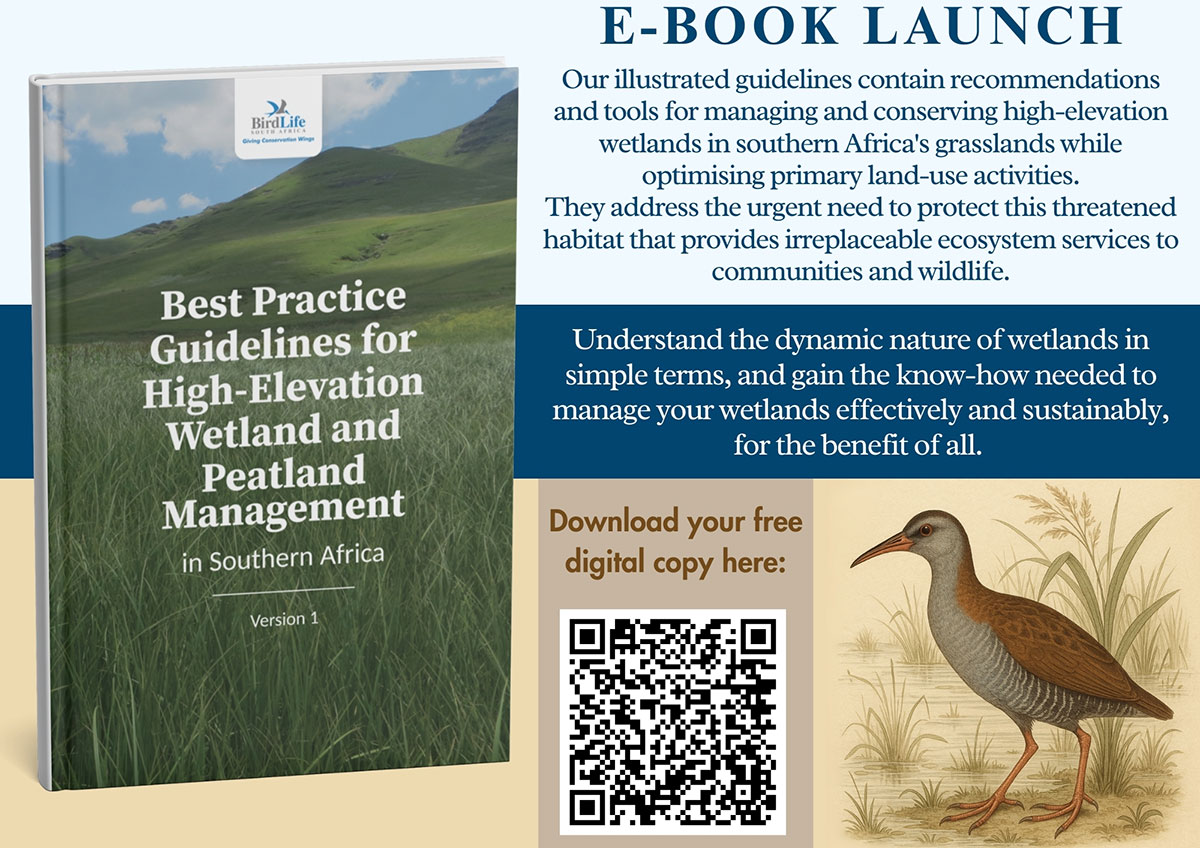
Wetlands deliver essential ecosystem services worth billions of Rands to replicate. Despite their economic value, they face ongoing threats worldwide. This is concerning for water-scarce regions like southern Africa, especially under climate change forecasts. High-elevation wetlands form part of the water towers in the upper reaches of our catchments that provide, support, and regulate water resources to many downstream users. While the impact of destroying wetlands is obvious, a more subtle impact is degradation through mismanagement.
Scientific understanding of wetlands and their management has improved but remains inaccessible to those responsible for stewarding these ecosystems, primarily private and communal landusers. BirdLife South Africa and partners have developed simplified and illustrated management guidelines for high-elevation wetlands (above 1 400 m) in southern Africa's mesic grassland regions. These guidelines are designed for land users (landowners, farmers, traditional authorities, protected area managers) and their advisors, providing practical knowledge to balance land use with wetland conservation, benefiting communities, future generations, and wildlife.
For more information, please contact:
Dr Kyle Lloyd, Wetland Conservation Project Manager/Rockjumper Fellow of White-winged Flufftail Conservation, BirdLife South Africa, kyle.lloyd@birdlife.org.za
The aim of this project, led by WildTrust, was to assess the feasibility of restoring degraded peatlands in selected areas of Maputaland by evaluating peat extent, degradation, carbon stock, and potential interventions. Through desktop studies, stakeholder engagement, and field investigations, the project identified specific peatland sites and evaluated their condition, carbon content, and restoration needs. Although some peatlands showed signs of degradation due to subsistence farming, eucalyptus plantations, and groundwater drawdown, they were found to be relatively shallow. Thus the overall carbon stocks were found to be relatively low. Because of the declining regional groundwater table, potential peatland restoration would require broader, long-term regional strategies focused on land use planning, governance, and community-based solutions to address peatland degradation.
The fieldtrip and conference of the International Mire Conservation Group was originally to be held in southern Africa in December 2020, with WetResT being the host. This entails developing the itinerary, managing the logistics, and hosting the international delegation. As a result of the COVID pandemic, The 2020 IMCG conference was postponed to 2022. In preparation, WetResT has started planning the preliminary program and advert to be issued through the IMCG.
WetResT participated in the RE-PEAT festival, hosted by an international youth-led organisation, with members in the Netherlands, Italy, UK, Ireland, Germany, and Estonia. WetResT hosted a photo contest (45 photo submission from around the world was received), as well as a live peat quiz (40 people participated). 500 Euro was received through ERA for the WETREST quiz and photo contest winners hosted as part of the RE-PEAT fest. There were two winners who each win a trip to Marakele. This money is allocated to cover their expenses. The winners were notified, and accepted their winnings.
UNEP (2022). Global Peatlands Assessment – The State of the World’s Peatlands: Evidence for action toward the conservation, restoration, and sustainable management of peatlands. Summary for Policy Makers. Global Peatlands Initiative. United Nations Environment Programme, Nairobi.
Funding was received for this project from the ERA Foundation. A consultant was appointed to assess the possibility of developing a national database of South African indigenous fruit and seed trees used for consumption and processing. The investigation considered the extent to which local fruits and seeds are used and provided an initial catalogue of the different species, uses, recipes and identifiable photographs. The outputs were captured in both a report and a stand-alone database.
H. Van Deventer, H., Adams, J.B., Durand, J.F., Grobler, R., Grundling, P.L., Janse van Rensburg, S., Jewitt, D., Kelbe, B., MacKay, C.F., Naidoo, L., Nel, J.L., Pretorius, L., Riddin, T and Van Niekerk, L. 2021. Conservation conundrum – Red listing of subtropical-temperate coastal forested wetlands of South Africa. Ecological Indicators, 130, 108077. DOI: https://doi.org/10.1016/j.ecolind.2021.108077.
Pretorius, L., Van Huyssteen, C., Brown, L., Grundling, A. and Downs, C. 2020. A characterization of wetland soils on the Maputaland Coastal Plain. South African Journal of Plant and Soil. Published online: 27 Nov 2020. DOI: 10.1080/02571862.2020.1814433
Bootsma, A., Elshehawi, S., Grootjans, A., Grundling, P. L., Khosa, S., Butler, M., and Schot, P. (2019). Anthropogenic disturbances of natural ecohydrological processes in the Matlabas mountain mire, South Africa. South African Journal of Science, 115(5-6), 1-9.
Elshehawi, S., Grundling, P., Gabriel, M., Grootjans, A. P., and Plicht, J. (2019). South African peatlands: a review of Late Pleistocene-Holocene developments using radiocarbon dating. Article 11, 1–14, http://www.mires-and-peat.net/, ISSN 1819-754X © 2019 International Mire Conservation Group and International Peatland Society, DOI: 10.19189/MaP.2018.KHR.329 1
Elshehawi, S., Gabriel, M., Pretorius, L., Bukhosini, S., Butler, M., van der Plicht, J., Grundling, P. and Grootjans, A.P. 2019. Ecohydrology and causes of peat degradation at the Vasi peatland, South Africa. Mires and Peat, 24(33), 1–21. (Online: http://www.mires-and-peat.net/pages/volumes/map24/map2433.php); doi: 10.19189/MaP.2019.OMB.StA.1815
Grundling, P-L. and Grundling, A. 2019. Appendix C: Peat Pressures, in Van Deventer et al. South African National Biodiversity Assessment 2018: Technical Report. Volume 2b: Inland Aquatic Realm. Council for Scientific and Industrial Research (CSIR) and South African National Biodiversity Institute (SANBI), Pretoria, South Africa. CSIR report number
CSIR/NRE/ECOS/IR/2019/0004/A and SANBI handle report no.
http://hdl.handle.net/20.500.12143/6230.
Grundling, P., Grundling, A.T. and Tererai, F. 2019. Wetland ecological infrastructure: making a case for restoration in the face of climate change and rising costs. Chapter 1 in: The Sustainable Water Resource Handbook - South Africa Volume 9. alive2green: Cape Town, pp. 14-24. (https://issuu.com/alive2green/docs/water_9_web).
Grundling P., Grundling A.T., De Villiers L. And Van Deventer, H. 2019. Extinguishing subsurface fires in peatlands with the sprouting water pressure method. Water Wheel 18 (5): 38-41.
Nieuwoudt, H., Grundling, P. L., du Toit, L., andTererai, F. (2018). Pietersieliekloof wetland rehabilitation project–Investing in the future. Water Wheel, 17(2), 26-28.
Pretorius, L., 2019. The survival riddle of Maputaland’s money trees. Veld and Flora, 105(1): 26-33.
Gabriel, M., Toader, C., Faul, F., Roßkopf, N., Grundling, P. L., van Huyssteen, C. W., and Zeitz, J. (2018). Peatland substrates in northern KwaZulu-Natal: a study of the forming environments, properties and an approach towards classification. South African Journal of Plant and Soil, 35(2), 149-160.
Grundling, A. Grundling, P.L. and Van Rooyen, L. 2018. Peatlands. Water Wheel, 17, pp 38 –40
Van Deventer, H., Smith-Adao, L., Collins, N.B., Grenfell, M., Grundling, A., Grundling, P-L.,
Impson, D., Job, N., Lötter, M., Ollis, D., Petersen, C., Scherman, P., Sieben, E., Snaddon, K., Tererai, F. and Van Der Colff, D. 2019. South African National Biodiversity Assessment 2018: Technical Report. Volume 2b: Inland Aquatic (Freshwater) Realm. CSIR report number
CSIR/NRE/ECOS/IR/2019/0004/A. South African National Biodiversity Institute, Pretoria.
http://hdl.handle.net/20.500.12143/6230